
search icon
Blogs Banner(1600 × 350 px)

Security-First Digital Transformation Strategy: Why Growth Needs Protection

Digital transformation promises speed, scale, and new business value. Yet many initiatives still fail because security is introduced too late.

According to a report by the National Institute of Standards and Technology (NIST), fixing security flaws after release is 80–100 times more expensive than addressing them with “secure by design” methods. This is why a strong digital transformation strategy must treat protection as a core requirement, not an add-on.

However, with the modernization of businesses, there are new entry points that are exposed, and threats move faster with hidden dependencies. This makes one thing certain: digital progress must be built on security from day one an essential element of any modern digital transformation strategy.

What “Security-First Digital Transformation Strategy” Means

Simply put, digital transformation is the use of technology to enhance and modernize your work processes. Maybe it involves migrating to the cloud, upgrading your data systems, or automating repetitive tasks. In fact, the beauty of digital transformation is that it looks different for every organization.

A Security-First Digital Transformation Strategy in place makes cybersecurity essential from the start. It embeds risk management with a secure design and resilient planning into the very start of digital programmes. Hence this is different from the traditional approach, where teams “bolt on” controls after systems go live. That old model no longer works optimally.

Why It’s Critical Now: The Evolving Threat Landscape

Several business drivers push organisations to move faster. Cloud platforms accelerate innovation. Hybrid work demands remote access. Ecosystem partnerships expand collaboration. To emphasize all these forces increase exposure.

Industry research has shown that billions of records have been exposed globally due to poor identity controls and weak access hygiene. Coupled with modern digital ecosystems, this creates a perfect storm, especially when security in your digital transformation strategy is treated lightly.

Given that two factors elevating the risk attributes are:

  • Third-party exposure: Vendors, partners, and external collaborators are associated with a business’s internal systems. Therefore, when they experience a breach or failure, it eventually boils down to your systems as well. So, your operations, data, and reputation are on the line too.
  • Legacy systems intersecting with modern architectures: Many organisations run older systems while adding cloud, edge, or converged IT/OT environments. Subsequently this mix increases complexity and reduces visibility.

Together, these trends create a strong case to make security foundational not optional for any digital transformation strategy.

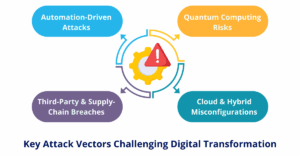
Key Attack Vectors Challenging Digital Transformations

Transformation efforts face an array of evolving attack vectors.

Automation-Driven Attacks

Malicious entities have evolved. And are using automated scripts and toolkits to exploit systems. They are leveraging automated scripts and pre-built toolkits to compromise weaknesses at scale. The speed is the real problem here. These tools work faster than manual patching cycles, which puts defenders at a disadvantage from the start. And with the advent of AI, automated threat behaviour has clearly reshaped the attack landscape. This has increased the need for cybersecurity digital transformation approaches.

Quantum Computing Threats

Quantum computing remains under development, but it is already sparking concerns about encryption security. The encryption safeguarding sensitive information today might not withstand quantum-enabled attacks in the future. They could theoretically break through encryption that current systems would take thousands of years to crack. Hence, it’s something businesses really need to get ahead of within their secure digital transformation plans.

Third-Party and Supply-Chain Breaches

Supply-chain attacks target external partners and then move upstream. Unmanaged access, shared credentials, and hidden dependencies make these attacks difficult to detect. Therefore, even a small vendor can become an entry point for a major breach.

Cloud and Hybrid-Platform Misconfigurations

These references widespread patterns observed across industries, and they show why transformation without strong security creates bigger risks for any digital transformation strategy.
Digital transformation attack vectors

Repercussions of Ignoring Security in Digital Transformation

Ignoring security in your digital transformation journey can lead to serious consequences:

  • Financial losses: The cost of responding to a breach is significant. Expenses for incident response, system recovery, legal fees, and regulatory fines create a domino effect across the organization.
  • Damage in reputation: Customers react swiftly to security failures. Additionally recovering from reputational damage requires a consistent demonstration of improved practices over extended periods. This isn’t something quarterly reports can fix.
  • Project delays: Security issues discovered late can halt or derail transformation roadmaps. Projects pause while teams address vulnerabilities.
  • Regulatory exposure: Compliance and enforcement are becoming stricter. GDPR non-compliance triggers significant fines. Data sovereignty laws come with serious legal consequences. Privacy regulations require strict accountability. Companies without strong security measures face audits, financial penalties, and ongoing regulatory scrutiny.
  • Business continuity interruption: Security incidents don’t just affect IT they disrupt entire operations. When systems go offline due to ransomware or breach containment measures, customer-facing services fail. Internal processes halt and SLA commitments get breached. The operational impact extends across functions, affecting revenue and customer satisfaction.

Core Pillars of a Security-First Digital Transformation

Building security into your digital transformation strategy isn’t a one-dimensional effort. It rests on several key pillars

  • Governance and Risk-Management
    Boards, CISOs, and engineering leaders must align early. Security-by-design helps reduce risk before systems go live.
  • Identity, Access, and Zero-Trust
    Identity has become the new security perimeter. With the old network boundaries pretty much dissolved, zero trust isn’t just a trendy concept. Rather it is about verifying every single access request, every time. No assumptions, no exceptions for a secure digital transformation.
  • Resilience and Recovery
    Cyber-resilience is your ability to recover swiftly after a security incident hits. The key ingredients? It is about having clear incident response protocols and continuity plans that have been tested in real scenarios.
  • Data Protection and Secure Architecture
    Data is everywhere now from cloud environments to edge devices and here’s the thing: secure data flows matter at every single touchpoint. So, it emphasizes the importance of protecting APIs, microservices, and distributed workloads. Secure architecture keeps data protected across environments.
  • Securing Your Extended Ecosystem
    Each vendor relationship, system integration, and external connection creates a possible vulnerability in your security setup. Hence effective management means running comprehensive vendor security checks, enforcing strict access controls, and embedding security clauses into contracts.
  • Weaving Security into Your Development Process
    Shift-left methodology is all about baking security into your development pipeline from day one. Ongoing monitoring and early threat detection need to be built into how you create software, not just how you react to incidents.
  • Culture and Human Factors
    People still play a major role in security incidents. Training, phishing simulations, and behavioural awareness reduce avoidable errors.
  • Metrics and Compliance
    Clear metrics help leaders measure security maturity. Verified compliance frameworks guide teams and ensure accountability.

These pillars allow organisations to move fast without compromising safety, hence reinforcing both security in digital transformation and long-term success.
Small Banner

How Hughes Systique (HSC) Embeds Security-First in Every Transformation

At Hughes Systique, we embed security into every stage of our digital work. We are Cyber Essentials Plus certified delivering defense-grade protection our clients can trust.

We are also SOC 2 Type II compliant. This certifies our commitment to stringent data security standards, process integrity, and operational excellence.

Certification


For our customers and partners, this means:

  • Security controls are implemented, consistently followed, and audited over time
  • Your data is handled with industry-recognized standards for confidentiality and integrity
  • You can rely on our processes, systems, and operations to be secure by design

Let’s transform together with confidence and security supported by a strong, security-first digital transformation strategy and a well-defined digital strategy roadmap.


X
We will get back to you!
X
We will get back to you!

More Blogs

×

Enquire Now


We will treat any information you submit with us as confidential

arrow back top