

AI Agent Security Framework: Guardrails, Governance and Risk Management
Read More

Across recent AI conferences and industry forums, one theme has consistently emerged: Sovereign AI. Governments, hyperscalers and entities from diverse sectors are discussing how AI systems should be built, deployed and governed within trusted (national or enterprise) boundaries.
These conversations reflect the state of AI. As it gets adopted by critical sectors, new strategic dependencies are emerging due to external reliance on infra, data and models. Hence, questions around data control, regulations, infra ownership and digital autonomy are now shaping how AI ecosystems are designed.
This shift has given rise to sovereign AI, which focuses on ensuring that data, models and infrastructure powering AI remain under trusted local control.
In this blog, we explore what it means, why it is gaining global momentum and how organizations can begin building sovereign AI systems.
At its core, sovereign AI refers to a nation’s or organization’s capabilities to develop, deploy and govern their AI. Basically, having complete ownership of one’s AI ecosystem. This includes all components of AI systems such as the infra, data pipelines, models and even talent. The idea is to move away from relying on external or foreign AI systems.
This concept is gaining more popularity as AI is becoming more important strategically. AI systems are processing sensitive data, of the people and of national strategic assets. For governments and organizations alike, this is raising concerns around data residency, compliance, transparency and long-term digital independence.
There are a few aspects along which the sovereignty of AI can be evaluated:
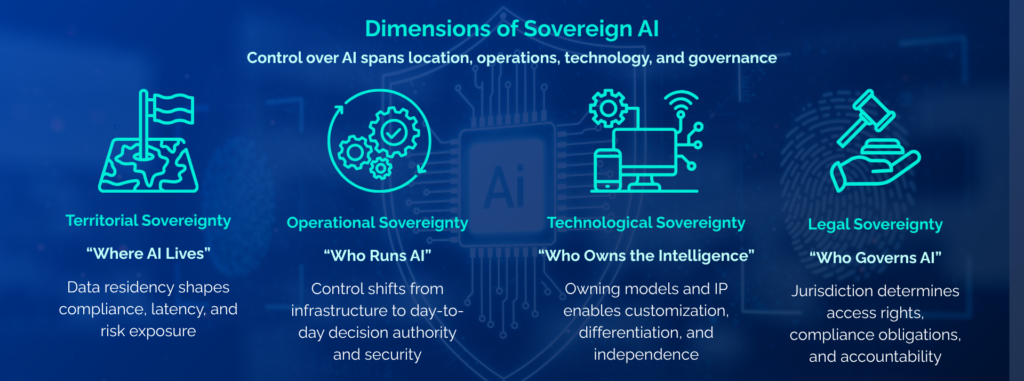
This aspect is concerned with where the data and compute physically reside. AI systems process huge volumes of data which requires substantial compute infrastructure, hosted in data centers.
Territorial sovereignty is achieved when these are located within approved geographic boundaries. This helps entities comply with data localization requirements and maintain better control over sensitive data.
This addresses who manages, operates and secures the AI environment. Even when the infra is locally hosted, operational control may still lie with external vendors. Sovereignty here means working with trusted entities to manage AI systems (whether its for deployment, monitoring, security, etc). Trusted entities can include national providers, regulated cloud operators or internal teams.
Tech sovereignty refers to ownership and control over underlying technology stack and IP. This includes:
By developing or maintaining control over these components, entities can reduce dependence on external providers. This also includes customizing for local languages, regulations and specific use cases.
Which jurisdiction governs the data, infrastructure and AI systems involved?
AI deployments often cover multiple geographies, raising questions about which laws apply to data access, compliance and dispute resolution. Sovereign AI ensures that governance frameworks align with national regulations, privacy laws and compliance requirements.
Together, these aspects help balance innovation with governance, scalability with compliance, and global collaboration with local control.
As AI becomes deeply embedded in economic systems, public infrastructure and enterprise operations, the question is how to deploy it responsibly and strategically. Many factors are driving the growing emphasis on sovereign AI.
Around the world, regulations around data privacy, residency and digital governance are becoming more strict. Many regions now state that sensitive data has to remain within national boundaries. These may include data such as healthcare records, financial information or telecom subscriber data. Sovereignty helps AI become transparent and easy to audit.
AI is being deployed on critical infrastructure, including public services, energy grids and transportation systems. Only depending on external platforms or infra for these capabilities can create strategic dependencies. Hence, sovereign AI provides the way for entities to retain control over these systems.
AI systems process highly sensitive data and influence important decisions. Governing data, model and compute within trusted ecosystems helps tackle risks such as:
AI models trained on global datasets may not always capture the local context or nuances. AI sovereignty allows teams to tailor models for local contexts.
As AI becomes a foundational layer of the digital economy, control over AI ecosystems is increasingly seen as a matter of technological and economic resilience.
Control over AI brings technology and economic resilience.
Sovereign initiatives help nations and organizations develop internal capabilities in areas such as:
This reduces the long term reliance on external technology providers.

Simply hosting models or data locally is not enough to achieve sovereignty. These efforts must look at the whole stack with data, models, infra and governance.
A sovereign AI stack covers many interconnected layers.
Here, the focus is on where the data resides and how it is secured/governed. The data must remain within approved geographical boundaries. They must also ensure authorized access for analytics and model training.
Key capabilities in this layer include:
This covers on how models are developed, trained, fine tuned and deployed. The focus is on using locally hosted models that are open source, or those developed internally.
Key capabilities include:
The infrastructure layer provides compute backbone for training and running AI models. The industry is moving towards sovereign cloud environments, domestic data centers, or enterprise-controlled infrastructure.
Core components include:
Sovereign AI also requires strong governance mechanisms to enforce security, compliance and accountability of systems. This layer oversees how AI systems are accessed, monitored and regulated across the entity:
In the coming years, we can expect to see the emergence of:
These will be designed to maintain regulatory and strategic control, while driving innovation locally. Various sectors will be able to deploy AI solutions that align with their unique compliance needs.
At the same time, sovereign AI does not mean full isolation. The future will likely involve a balance between global collaboration and trusted local control. Organizations will leverage open innovation while ensuring that critical datasets, infrastructure and AI capabilities remain governed within appropriate jurisdictions.