


Engineering Peak Season Success with Smarter Retail Inventory Management
Read More

Imagine a loyal customer visiting your online store to resolve a simple issue. This shopper spent thousands of dollars with your brand last year, yet today they feel like a total stranger. They want to return a damaged dress, but your current chatbot fails to recognize their history or value. Instead of personalized help, it demands a 16-digit order number, creating immediate friction that kills brand loyalty instantly. You risk losing more than just one sale; you risk losing their entire lifetime value in a single interaction.
This scenario happens every single day. Retail leaders now face a growing crisis where data silos prevent true deep personalization, and Manual processes slow down every single department. These bottlenecks drain your total profit margins and with competition getting much fiercer now, traditional automation is no longer enough. You need digital labour that works and a system that thinks.
The industry is moving past simple bots. We are entering the era of digital employees. These agents do not just talk. They execute complex tasks with precision and bridge the gap between data and action. This is the shift towards autonomous retail. It starts with understanding a new architecture.
Retailers today are drowning in disconnected data. The global AI for customer service market was valued at USD 13 billion in 2024 and is projected to reach USD 84 billion by 2033, growing at 23.2% annually. There is information in CRM, the POS system holds transaction records, E-commerce platforms track every digital click, and loyalty programs live in a separate database. These systems rarely talk to each other. This fragmentation creates massive operational blind spots.
Support teams handle roughly 2,000 return requests monthly, with 60% being routine issues that could be handled automatically. They handle thousands of repetitive, manual queries like “Where is my package?” Being the top question. Human agents spend hours on these tasks. This leads to high burnout and turnover which also drives up your operational costs and hence there should be a way to automate logic.
Most companies started with basic automation. They used simple rules to trigger emails. Then came generative AI in retail which helped with product descriptions and blogs. It could summarize long customer service transcripts. However, it still required a human driver. It provided the “what” but not the “how.”
Now, we see the rise of agentic AI in retail. This technology represents a massive functional leap. Unlike older models, agentic systems are autonomous. They function as specialized digital workers and understand specific business goals. They access real-time data to make decisions and also execute workflows without constant human prompts. The shift from rule-based automation to reasoning-based agents represents a fundamental breakthrough in AI maturity.
An agent does more than answer questions. It identifies a problem and fixes it, It checks inventory levels across all stores while also initiating a refund in the CRM. It even triggers a personalized apology email. This is the power of “doing.” It transforms AI from a tool into a teammate. The eCommerce market grew from $7.25 billion in 2024 to over $9 billion in 2025, driven largely by AI-powered personalization and automated support.
Salesforce recently introduced a groundbreaking new platform. Agentforce is the centre of this revolution. It allows to build custom agents which live within the Salesforce ecosystem. They connect directly to the Data Cloud and they it always uses fresh data.
Agentforce uses a sophisticated reasoning engine. It does not follow a rigid script. Instead, it creates a plan for every query. It analyses the customer’s intent first. Then, it selects the best digital tools after which it performs the task and reports back.
Core Capabilities of Digital Agents:
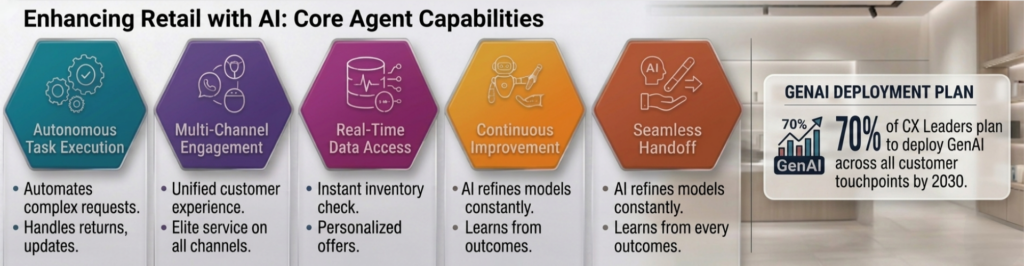
Using Salesforce for retail isn’t just a tech choice but a strategic move. It gives retailers one unified platform to grow and scale. Instead of running AI tools in separate silos, everything works together on a single, secure data layer. The result is a simpler tech stack, smoother operations, and stronger data security.
Logistics is the heartbeat of any retailer. Internal logistics inefficiencies cost India’s organised retail sector over ₹2,000 crore annually, showing how critical efficient logistics is to retail profitability and operations. Yet, it is often the most manual. AI in retail supply chain operations is changing. For retail operations, 57% of C-suite executives cite decision-making as the most important operational benefit of AI, making it the top priority among leadership. Agents can now monitor global shipping lanes. They spot potential delays before they happen after which they don’t just alert your team but also suggest specific, actionable solutions.
Consider a sudden storm in Mumbai. An agent sees the weather report. It checks which shipments are in transit, automatically reroutes trucks to safer paths, notifies customers about the slight delay all the while offering a small loyalty point bonus. All of this happens in seconds. No human manager had to intervene. This level of speed is now possible.
We have all used frustrating chatbots before which loop the same useless answers with no end in sight. But finally conversational AI in retail is evolving. Modern agents understand context and nuance. They remember what you said five minutes ago. They recognize your frustration through your typing.
These agents act as personal shopping assistants. They don’t just list products for you. They curate outfits based on your style and also check if a size fits your history.
Why Modern Conversations Convert Better:
High-quality conversations drive much higher conversions. Customers feel heard and valued by you which builds deep trust over long periods. It turns casual browsers into brand advocates.
The future of AI in retail is starting to feel very real. We’re heading towards a world where stores can run almost on their own, with digital systems taking care of routine back-office work. That shift will give human teams more space to focus on creative thinking, strategy, and better customer experiences. Many companies are already moving in this direction with around 70% of CX leaders say they plan to bring generative AI into several customer touchpoints within the next couple of years. Even the chatbot market reflects this momentum, growing rapidly and expected to more than triple in value by 2030.
For retailers, this isn’t something to put off. The gap between those who are experimenting with AI and those who aren’t is getting wider. Early adopters are already seeing the benefits—smoother operations, faster problem-solving, and stronger customer relationships over time. This isn’t about hype or buzzwords anymore; it’s about practical change happening right now. Simple chatbots were just the beginning. What’s emerging now is a new kind of intelligent, autonomous support that’s quietly reshaping how retail works.
Steps to Start Your Transformation:
Retail is gradually moving toward a model where digital agents handle many routine operational tasks. Customer queries, inventory monitoring, order management, and logistics coordination can increasingly be managed by intelligent systems.
The trend is already clear. Nearly 70% of customer experience leaders plan to deploy generative AI across multiple touchpoints in the next few years, and the chatbot market itself is projected to more than triple in value by 2030.
For retailers, delaying adoption carries its own risk. Companies that begin experimenting with autonomous systems today are already seeing improvements in efficiency, decision-making, and customer satisfaction.
Starting the journey toward agentic AI typically begins with a few practical steps.
Implementing agentic systems also requires strong technical expertise.
HSC works closely with retail organizations to design and deploy these solutions. Our teams help retailers integrate Salesforce platforms, prepare their data environments, and build AI agents that align with real business goals.
The result is not just automation but a smarter operating model where digital agents support human teams across the entire retail ecosystem.
For retailers ready to move beyond traditional automation, the next stage of transformation is already within reach.