Operational fragmentation is one of the biggest barriers to performance across the hospitality sector. Many properties continue to run on disconnected systems such as separate reservation platforms, isolated payment processors, and manually managed housekeeping workflows. As different operations operate in silos due to the use of different tools, hotels almost always struggle to match the performance of properties running integrated systems. This in turn has adverse effects on metrics like RevPAR and administrative efficiency.
According to the Access Hospitality / HSMAI Europe Study (2025), 47% of hotel operators are running 2 to 4 disconnected systems simultaneously while 25% are running 5 or more. This makes them lose somewhere between 322 to 470 hours per year just switching between unconnected systems.
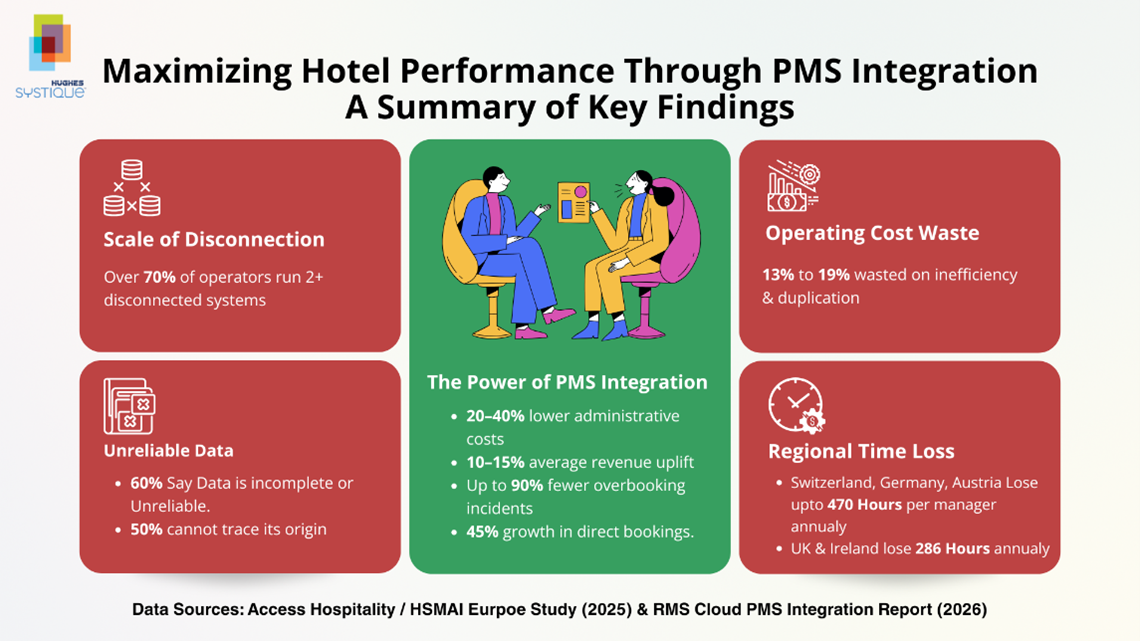
A property management system is a software that centralizes data into a single cloud-based platform. It helps staff at hotels and real estate set-ups to digitize the daily operations and eliminate time-consuming, paper-heavy tasks.
A well-designed property management system (PMS) becomes the operational backbone that synchronizes every revenue generating function and guest-facing function into a single, auditable workflow.
A hotel property management system is the software that centralizes every critical function of running a property into one unified platform. It manages reservations, guest check-ins and check-outs, billing, room availability, housekeeping schedules, guest communication, and financial reporting all from a single dashboard.
The gap between a capable property management system and a weak one is stark. A well-built system gives your team a clear and real-time view across the entire operation. A poor setup meanwhile compels the property owner to use separate tools, re-entering the same data and losing important hours to work that shouldn’t be manual in the first place.
Here’s what happens during a typical day.
A strong hotel property management system orchestrates all this automatically.
For operations, technology, and revenue leaders, the decision to upgrade or consolidate a PMS directly affects the KPIs that define how their departments perform. Some of the notable areas include occupancy rate, Average Daily Rate (ADR), Revenue Per Available Room (RevPAR), Net Promoter Score (NPS), and cost per occupied room.
The global hospitality PMS market is expanding at a 7.14% CAGR, rising from $1.62 billion in 2025 to an estimated $2.26 billion by 2030. Properties that delay modernization are not preserving the status quo but are accumulating a competitive deficit that compounds annually.
Most hotel properties still operate with disconnected systems. For instance, a booking system is not connected to the payment processing system. Emails /messages are scattered across different platforms. The housekeeping schedules are still managed in spreadsheets. This fragmentation creates massive inefficiencies.
It compels the staff to inefficiently manage the time as they have to manually transfer the information between systems. Hence crucial customer details either get lost or are entered incorrectly. As the guest preferences disappear, revenue opportunities are missed. And worst of all, your team gets frustrated because they’re working harder, not smarter.
This is where property management systems for hotels become essential. When you consolidate everything into one platform- the operation becomes visible. Bottlenecks surface and coincidentally opportunities appear.
Not every hotel property management system includes everything your operation needs. Here’s what separates capable platforms from mediocre ones.

Sits at the center of a connected hotel system. An efficient hotel system needs real-time updates to prevent overbookings, and manage group blocks. They also have to sync availability across all channels. When your website and every booking platform pull from the same inventory, mistakes disappear.
Demand high levels of speed and accuracy. Self-service check-in reduces wait times whereas mobile check-in lets guests enter rooms before arrival. Digital key systems eliminate physical cards. Nowadays, with the penetration of technology, these aren’t perks, but essentials every guest assumes a hotel will provide.
Transform interactions. For example, automated messages welcome guests’ pre-arrival and remind them of checkout times. When actual guest data is triggered, this feels personalized because of which guests respond with better reviews and repeat visits.
Undergoes a transformation. Instead of printed lists, staff receive tablet assignments and update status in real-time. The front desk immediately sees which rooms are ready. This leaves no room for guess work thereby working as a well oiled machine.
Becomes accurate and immediate. Automated billing prevents errors. Integrated payment processing speeds check-out. Reports show revenue by source and profitability by room type. You manage by data, not intuition.
Hotels, which implement strong property management systems typically see measurable improvements within months. Here’s what happens in practice.
Several elements distinguish hotel property management systems that truly serve your operation. Here are a few that can truly impact the way a hotel uses technology efficiently:
Your system needs to connect seamlessly with payment processors, booking engines, channel managers, accounting software and communication platforms. Weak integration forces manual data transfers between systems which in turn defeats the entire purpose.
Your team works across the property which includes front desk, housekeeping, maintenance and also management. Cloud-based systems with strong mobile interfaces let staff work effectively wherever they are.
Choose a platform designed for properties like yours, not a generic solution because boutique hotels have different demands than large resorts.
The best software doesn’t help if your team does not know how to use it. Look for vendors which provide strong training, responsive support, and smooth implementation processes.
For Leaders evaluating where their property sits in the PMS landscape, Oracle’s Opera is the most important reference point. It has held the largest market share by rooms for over two decades and remains the standard for large chains and enterprise hotel groups.
The Opera property management system offers deep configurability, a mature integration ecosystem with over 1,000 pre-integrated services, and a proven track record across multi-property deployments. Major chains including Hyatt, BWH Hotel Group, and Meliá Hotels International have made long-term commitments to Opera Cloud, Oracle’s cloud migration of the platform.
The practical consideration for independent and mid-market properties is cost and complexity. Opera is built for enterprise scale both in terms of implementation overhead as well as an enterprise friendly licensing model. For property types below a specific room count or operational complexity, properties are often less well served by platforms like Oracle / Micros Opera, Oracle / Micros Symphony [F&B], and other monolithic systems because of their cloud native architecture, greater implementation timelines and pricing structures more suited to groups than independent operators.
Cloudbeds has launched predictive demand analytics. Mews raised $300 million in early 2026 at a $2.5 billion valuation to pursue an AI-driven hospitality operating system. Apaleo’s API-first marketplace enables autonomous pricing and guest communication agents

If you’re evaluating whether to implement or upgrade your property management system, start with your actual pain points. What takes your team too long? Where do errors occur? Which manual processes cost you money? A strong hotel property management system should be able to directly address these issues and solve them on the go.
Beyond functionality, evaluate the vendor’s commitment to ongoing improvement. Technology evolves. Your system needs to evolve with you. Vendors who actively add features and integrate emerging technologies are better partners than those maintaining static platforms.
Implementation matters as well. A good vendor handles data migration, provides training, and stays responsive during transition. Rushing this creates costly mistakes. The future of property management systems in hotels will increasingly feature artificial intelligence, deeper integrations with smart room technology, and more sophisticated revenue management. Systems that learn from your historical data and suggest pricing adjustments are already here. Systems that connect to smart room devices to optimize guest experience are emerging.
The hotels positioned best for the future are those who invest in strong systems now. They’ll have the infrastructure and data foundations needed to take advantage of these advancements. They’ll have staff trained on current systems who can adapt as features evolve.